
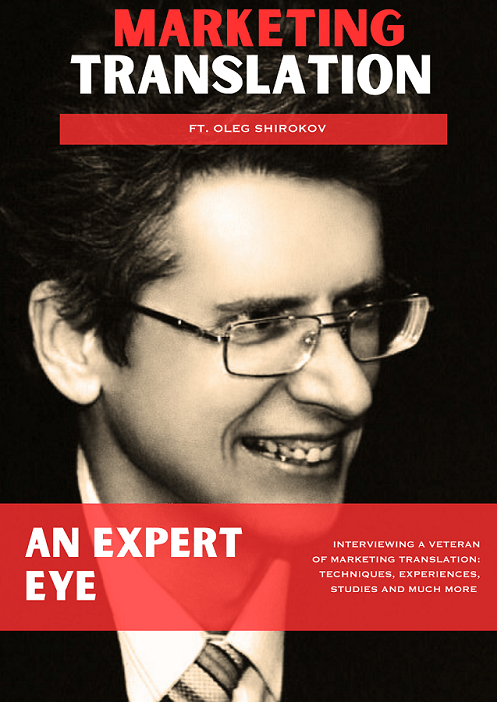
Nota: l’intervista originale è in inglese, e se ne consiglia la lettura per una migliore esperienza, ma potete trovare una traduzione in italiano subito a seguire.
[English version]
Hello everybody and welcome! In this interview, focused on the translation field, we have a guest with more than twenty years of experience: Translator Oleg Shirokov. Given his extensive (and impressive) background, I thought it would’ve been interesting to start this interview and learn from such expert.
So, Oleg, welcome and thank you so much for your precious time. The first thing I’d like to ask you is, how did you become a translator? What course of study did you take? And which were your first works?
Gabriele, thank you for the opportunity to tell my story. I’m not going to give advice on how to become a successful translator. I will just tell about my journey.
I’ve always had an interest in foreign languages. In technical university, studying to be a programmer, I studied English in a special group with advanced English students. After passing the exam of scientific and technical literature translation, I obtained the Certificate of Technical Translator from English to Russian.
After completing 3-year English courses in Department of Foreign Trade of Russian Federation, I obtained the Bachelor of Arts in English.
At first I worked as a software developer for 8 years. But translation has always been my passion!
I fondly remember my first translation.
It was a 200-page collection of papers from the International Conference on Fiber Optic Communication Systems held in Japan. The customer, All-Union Translation Center, asked to translate it in a tight deadline. This was a new field in the telecommunications industry, and at that time there were no dictionaries on fiber optics. So I compiled my own Glossary of terms on this subject. It was a very interesting job! First of all, this was my first translation to be published by All-Union Translation Center. Secondly, it was very interesting to explore a new field in the telecom industry.
Then I translated several articles for Scientific American magazine. One of the articles was “The first mechanical computer invented by Charles Babbage in the 19th century“. It was a huge mechanism made of gears, weighing several tons!
I also translated articles for the British Creative Arts Magazine about creating computer models and animated characters. I learned a lot of interesting things about new software for computer modeling!
After those first works, how and why did you start focusing on the field on Marketing translation (as well as SEO, SaaS, etc..)?
With 8 years of experience as a programmer, I had a deep understanding of the software developer profession and a deep knowledge of computer terminology. Therefore, I became a software localizer. I translated articles for programmers in MSDN and TechNet, which were published on Microsoft.com. This is where my programming knowledge and experience came in handy.
Since 2011 I have localized all versions of Microsoft Visio for Russian users. This required strict adherence to Microsoft terminology according to Microsoft Terminology Portal and Microsoft Style Guide. I also localized a large Verint Systems ERP system.
I localized 12,000 software localization projects for SaaS companies.
In Marketing Translation, it’s important to communicate marketing ideas and create content in the target language so that those ideas are clear and appeal to the right target audience. Marketing Translation is interesting for me because unlike technical translation, where accuracy is required, there is more freedom for creativity. You can paraphrase sentences, break them into shorter sentences, use synonyms and metaphors.
I localized dozens of the top brand’s websites including LexisNexis, Verint Systems, NDS (Net Display Systems).
Which are the main challenges and difficulties related to Marketing translation? Can you give us some examples of translation challenges you overcame, and your thought process?
There are many challenges in Marketing Translation.
Here are my Marketing Translation techniques that I use to solve these challenges:
- Have a good understanding of your target audience
- Localized text should be written in a language that is clear and understandable to every reader
- Localized text should catch the reader’s attention
- Localized text should offer a benefit to the consumer of the product/service
- Localized text should evoke positive emotions
- Localized text should be concise (short sentences and words)
Here are 2 examples of translation challenges.
Example 1. I recently translated medical marketing materials that included instructions on anesthesia for patients at a clinic in Switzerland. There were 2 options how to translate the term “Hospital”:
1. Clinic (for patients in Switzerland)
2. Hospital (in Russian – “Больница”) (for patients in Russia).
Since these were documents for a clinic in Switzerland, I chose the translation “Clinic”.
Tip: you must understand who your reader (target audience) is and what country they live in.
Example 2. “Business Booster”
When localizing the AsiaBC website, I met “Business Booster” in the text.
It was a product name – a name of services package. I decided to leave “Business Booster” in English, because business owners in Russia understand Business English well. The customer approved this decision.
Tip: Ask the customer on a case-by-case basis: should the product name be translated?
Which are the translations you are the most proud of related to the field of Marketing?
I localized White Paper – an official description of a new type of printing technology – Nanographic Printing™ technology invented by Benny Landa that differs from other printing technologies because it uses NanoInk – a proprietary water-based ink with nano-pigment particles that measure tens of nanometers in size.
Unlike lithography, Nanographic Printing™ technology harnesses the advantages of digital printing, including shorter turnaround times, reduced waste, the ability to print runs as short as one copy, as well as variable data printing. At the same time it also offers offset qualities.
For the newbie and/or wannabe translators, when you receive a commission, how do you organize your work? Can you also share some techniques and way of thinking when facing a translation?
You can read my tips about organizing translator’s work in my article “My Flawless translation Method” on my LinkedIn profile here https://www.linkedin.com/in/oleg-shirokov-73143510/
Finally, how can one improve and be recognized as translator?
In every translation project, you should strive to ensure the highest quality of translation and satisfy all individual and additional requirements of the customer (layout, creation of a glossary, editing of previous translations on similar subjects, etc.). In other words you should do extra mile to make the client happy and to be dedicated translator for every client.
Oleg, thank you so much for your time and your insight! I hope this interview was of interest to any new translator.
Following, here are Oleg’s contact to those interested:
LinkedIn – https://www.linkedin.com/in/oleg-shirokov-73143510/
Email – oleg.shirokov@gmail.com
Skype ID – oleg3313171
WhatsApp – CONTACT ME ON WHATSAPP: +79152537470 https://wa.me/79152537470
[Versione italiana]
Ciao a tutti e benvenuti! In questa intervista, incentrata sul settore della traduzione, abbiamo un ospite con più di vent’anni di esperienza: il traduttore Oleg Shirokov. Dato il suo vasto (e impressionante) background, ho pensato che sarebbe stato interessante iniziare questa intervista e imparare da un tale esperto.
Oleg, benvenuto e grazie mille per il tuo prezioso tempo. La prima cosa che vorrei chiederti è: come sei diventato traduttore? Quale corso di studi hai seguito? E quali sono stati i tuoi primi lavori?
Gabriele, grazie per l’opportunità di raccontare la mia storia. Non darò direzioni su come diventare un traduttore di successo: quello che farò sarà raccontare il mio percorso.
Ho sempre avuto interesse per le lingue straniere. All’università di Tecnologia, mentre studiavo per diventare programmatore, ho frequentato un corso speciale di inglese con studenti avanzati. Dopo aver superato l’esame di traduzione di letteratura scientifica e tecnica, ho ottenuto il certificato di traduttore tecnico dall’inglese al russo.
Dopo aver completato i corsi triennali di inglese presso il Dipartimento del Commercio Estero della Federazione Russa, ho ottenuto il Bachelor of Arts in inglese.
All’inizio ho lavorato come sviluppatore di software per 8 anni. Ma la traduzione è sempre stata la mia passione!
Ricordo con affetto la mia prima traduzione.
Si trattava di una raccolta di 200 pagine di documenti della Conferenza internazionale sui sistemi di comunicazione in fibra ottica tenutasi in Giappone. Il cliente, All-Union Translation Center, ha chiesto di tradurlo in tempi stretti. Si trattava di un campo nuovo nel settore delle telecomunicazioni e all’epoca non esistevano dizionari sulle fibre ottiche. Così ho compilato il mio glossario di termini sull’argomento. È stato un lavoro molto interessante! Innanzitutto, questa è stata la mia prima traduzione pubblicata dal Centro di traduzione dell’Unione Europea. In secondo luogo, è stato molto interessante esplorare un nuovo campo dell’industria delle telecomunicazioni.
Poi ho tradotto diversi articoli per la rivista Scientific American. Uno degli articoli era “Il primo computer meccanico inventato da Charles Babbage nel XIX secolo“. Si trattava di un enorme meccanismo fatto di ingranaggi, che pesava diverse tonnellate!
Ho anche tradotto articoli per la rivista britannica Creative Arts Magazine sulla creazione di modelli al computer e personaggi animati. Ho imparato molte cose interessanti sui nuovi software per la modellazione al computer!
Dopo questi primi lavori, come e perché hai iniziato a concentrarti sul campo della traduzione di marketing (oltre che SEO, SaaS, ecc.)?
Con 8 anni di esperienza come programmatore, avevo una grande esperienza come sviluppatore di software e una profonda conoscenza della terminologia informatica. Pertanto, sono diventato un localizzatore di software. Ho tradotto articoli per programmatori in MSDN e TechNet, pubblicati su Microsoft.com. È qui che le mie conoscenze di programmazione e la mia esperienza si sono rivelate utili.
Dal 2011 ho localizzato tutte le versioni di Microsoft Visio per gli utenti russi. Ciò ha richiesto una stretta aderenza alla terminologia Microsoft secondo il Microsoft Terminology Portal e la Microsoft Style Guide. Ho anche localizzato un complesso sistema ERP di Verint Systems.
Ho localizzato 12.000 progetti di localizzazione di software per aziende SaaS.
Nella traduzione di marketing, è importante comunicare le idee di marketing e creare contenuti nella lingua di destinazione in modo che tali idee siano chiare e si rivolgano al giusto pubblico. La traduzione di marketing è interessante per me perché, a differenza della traduzione tecnica in cui è richiesta precisione, c’è più libertà di creatività. È possibile parafrasare le frasi, suddividerle in frasi più brevi, usare sinonimi e metafore.
Ho localizzato decine di siti web di marchi importanti, tra cui LexisNexis, Verint Systems, NDS (Net Display Systems).
Quali sono le principali sfide e difficoltà legate alla traduzione di marketing? Puoi fornirci alcuni esempi di sfide di traduzione che hai affrontato?
Ci sono molte sfide nella traduzione per il marketing.
Ecco alcune delle mie tecniche:
- Avere una buona comprensione del pubblico di riferimento
- Il testo localizzato deve essere scritto in una lingua chiara e comprensibile per ogni lettore.
- Il testo localizzato deve catturare l’attenzione del lettore
- Il testo localizzato deve offrire un beneficio al consumatore del prodotto/servizio
- Il testo localizzato deve evocare emozioni positive
- Il testo localizzato deve essere conciso (frasi e parole brevi).
Due esempi di sfide di traduzione:
Esempio 1. Di recente ho tradotto materiale di marketing medico che includeva istruzioni sull’anestesia per i pazienti di una clinica in Svizzera. C’erano due opzioni per tradurre il termine “Ospedale“:
- Clinica (per i pazienti in Svizzera)
- Ospedale (in russo “Больница”) (per i pazienti in Russia).
Trattandosi di documenti per una clinica in Svizzera, ho scelto la traduzione “Clinica”.
Suggerimento: dovete capire chi è il vostro lettore (pubblico target) e in quale Paese vive.
Esempio 2. “Business Booster“
Durante la localizzazione del sito web di AsiaBC, ho incontrato “Business Booster” nel testo.
Si trattava del nome di un prodotto, ovvero di un pacchetto di servizi. Ho deciso di lasciare “Business Booster” in inglese, perché gli imprenditori in Russia capiscono bene l’inglese commerciale. Il cliente ha approvato questa decisione.
Suggerimento: Chiedere al cliente caso per caso: il nome del prodotto deve essere tradotto?
Alcuni esempi di traduzioni del settore marketing di cui vai più fiero?
Ho localizzato il White Paper, una descrizione ufficiale di un nuovo tipo di tecnologia di stampa, la tecnologia Nanographic Printing™ inventata da Benny Landa, che si distingue dalle altre tecnologie di stampa perché utilizza il NanoInk, un inchiostro proprietario a base d’acqua con particelle di nano-pigmento delle dimensioni di decine di nanometri.
A differenza della litografia, la tecnologia Nanographic Printing™ sfrutta i vantaggi della stampa digitale, tra cui tempi di esecuzione più brevi, riduzione degli scarti, capacità di stampare tirature di una sola copia e stampa di dati variabili. Allo stesso tempo offre anche le qualità della stampa offset.
Vorresti dare qualche consiglio ai traduttori in erba per quando riceveranno una commissione, o su come organizzare il lavoro?
Potete leggere i miei consigli sull’organizzazione del lavoro di traduttore nel mio articolo “Il mio metodo di traduzione impeccabile” sul mio profilo LinkedIn qui https://www.linkedin.com/in/oleg-shirokov-73143510/.
Ultima domanda: come si può migliorare ed essere riconosciuti come traduttori?
In ogni progetto di traduzione, dovreste impegnarvi a garantire la massima qualità della traduzione e a soddisfare tutte le richieste individuali e aggiuntive del cliente (impaginazione, creazione di un glossario, revisione di traduzioni precedenti su argomenti simili, ecc.) In altre parole, dovreste fare il possibile per rendere il cliente felice e per essere un traduttore dedicato per ogni cliente.
Oleg, grazie mille per il tuo tempo! Spero che questa intervista sia stata interessante per tutti i nuovi traduttori. Di seguito, ecco i contatti di Oleg per chi fosse interessato:
LinkedIn – https://www.linkedin.com/in/oleg-shirokov-73143510/
Email – oleg.shirokov@gmail.com
ID Skype – oleg3313171
WhatsApp – +79152537470

 Pillole di Folklore e Scrittura